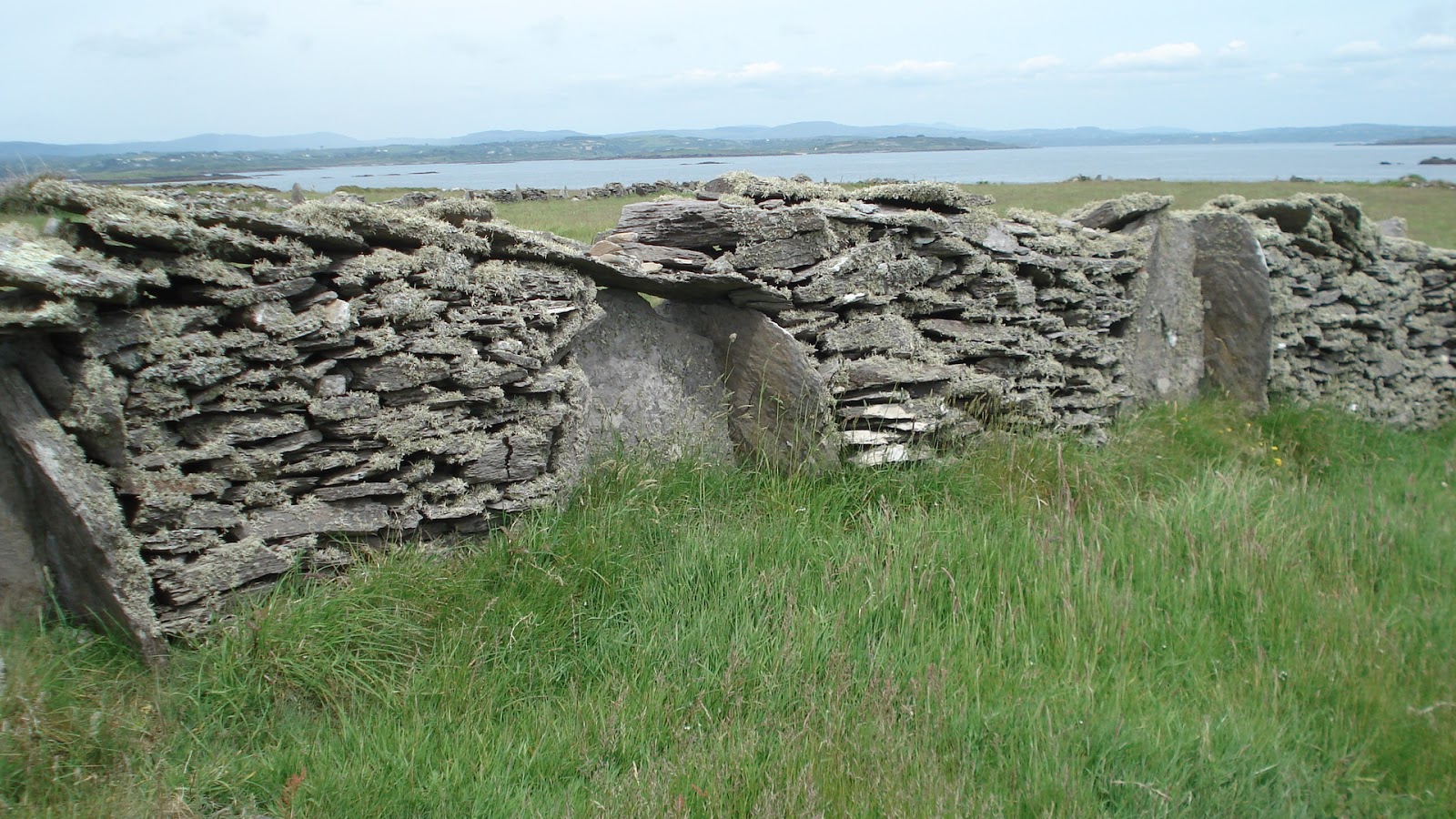
This wonderful example of skilled walling is passed by many thousands of walkers every year at the head of Great Langdale, in Cumbria every year.
It's only a few minutes away from a favourite pub of mine, The Old Dungeon Gyll.
Tuesday, April 24, 2012
Thursday, April 19, 2012
Grouse Butts
Sunday, January 29, 2012
Archaeological find?
This is the third of these I've found this past year. I thought it was a 'cup-marked-stone', maybe four or five thousand year old. These stones are common enough in the UK, Ireland and elsewhere.However the archeologist from our national park thought that it was a stone which was used at the base of a base stone socket for a door to swing on. These too were once common in farms/houses and I've even heard of circular grind stones being used for them too in Ireland. It's never been used as the inside was perfectly unworn. It's now recorded and back in the wall it came from.
Thursday, December 8, 2011
Goathland
His barn had some lovely long gate posts and we selected two to act as posts for a new, much smaller gate entrance.
The farm sign below was set on a large stone cemented in place and it too was partially fixed in place with cement.
If I'd had more time I would have spent it making sure the copes were perfectly level.
I had noticed and old much smaller and partially removed wall at the back of the house. What remained had reasonable 'half moon' shaped copes. Further away hidden behind more stone were a couple of pallets containing what remained of the copes. We soon estimated that we'd be just about have enough. It turned out we were about five short - and these I made!
Tuesday, August 30, 2011
Sheep Hole Isle of Man
It's a sheep hole, (I don't know what they are called in the IOM)
But it is the only one I've ever seen in a wall built of vertically placed stone!
It is just a short walk on the coastal path out of Port Erin.
Meanwhile I met a farmer from the other side of the moors here in North Yorkshire (Farndale) and his local word for these holes was, "pop holes" which I'd never heard of before.
Sunday, June 12, 2011
Historic Wheelhouse
The phone call was from a builder I didn't know but he told me he had got my name from someone I'd done some walling for. "Would I be interested in rebuilding/repairing some walling on a wheelhouse" up near Commondale?" s Mmmmmm intersting!
Wheelhouses are relatively uncommon in the North York Moors and were built so horses could drive machinery such as threshing machines. This one at West House Farm is much the same as others, in that it worked by the horse walking in circles turning a drive shaft just below the ground turned various pulleys which in turn powered whatever farm machinery was being used.
On the left is the wheelhouse and rather rough and uneven stonework, some of which was falling down.
All the ones I've seen were built with sides. This one was originally constructed with open sides which had at sometime been filled with drystone work. The farmer had lived there for over 47 years and they'd always been there he said. Why were the gaps between the columns filled in? The farmer thought that it was unlikely that a horse would be able to work in winter during the bad weather on this relatively exposed open site close to the moors. Perhaps it was originally built 'on the cheap', but then filled in when it's faults were discovered.
And here it is 4 days later after my attentions.
Well it's hard to see the difference but I had deliberately tried to ensure the outer stones were reused with their weathered surfaces showing again.
The whole building had been reroofed, keeping as much of the original timbers as possible. Bat roosting holes were provided under the ridge stones and accessed through small holes left by the builder who used lime mortar throughout.
The owner is now going to removed the tons of sheep dung from inside now it's also been empted of assorted tractor tyres and other vintage unwanted old farming machinery!
Wheelhouses are relatively uncommon in the North York Moors and were built so horses could drive machinery such as threshing machines. This one at West House Farm is much the same as others, in that it worked by the horse walking in circles turning a drive shaft just below the ground turned various pulleys which in turn powered whatever farm machinery was being used.

On the left is the wheelhouse and rather rough and uneven stonework, some of which was falling down.
All the ones I've seen were built with sides. This one was originally constructed with open sides which had at sometime been filled with drystone work. The farmer had lived there for over 47 years and they'd always been there he said. Why were the gaps between the columns filled in? The farmer thought that it was unlikely that a horse would be able to work in winter during the bad weather on this relatively exposed open site close to the moors. Perhaps it was originally built 'on the cheap', but then filled in when it's faults were discovered.
And here it is 4 days later after my attentions.Well it's hard to see the difference but I had deliberately tried to ensure the outer stones were reused with their weathered surfaces showing again.
The whole building had been reroofed, keeping as much of the original timbers as possible. Bat roosting holes were provided under the ridge stones and accessed through small holes left by the builder who used lime mortar throughout.
The owner is now going to removed the tons of sheep dung from inside now it's also been empted of assorted tractor tyres and other vintage unwanted old farming machinery!
Saturday, June 4, 2011
Browside - medieval boundary

For some reason the copes on most of the wall are triangular shape but on either side of the old entrance to the farm they are replaced by neat blocks - some of which I've had to manufacture.
A short distance away on Browside is this wall I built a year ago. Notice the huge field clearance boulder. Over the years the owner had collected several large boulders from the fields he was 'improving'. I persuaded him to push it into place using a large digger. I rather like it!
Subscribe to:
Posts (Atom)